
May 14
/
Beyond Social Science
Will AI Replace Jobs in International Development?
The question of AI and jobs in international development is no longer hypothetical. Inside NGOs, UN agencies, and bilateral donors, the conversation is already happening — and the honest answer is more complicated, and more uncomfortable, than most of us want to admit.
There's a conversation happening quietly right now. It's not in the strategy documents yet. It's in the hallways, the Slack channels, the pauses after a budget meeting. Someone has found a tool that can do what a team of people used to do. Faster. Cheaper. At scale. And the question underneath all of it — the one people are asking but not always saying out loud — is: what happens to us?
The Story We're Telling Ourselves
Most development professionals have landed on a reassuring answer.
AI is a tool. A powerful one, yes — but a tool. It handles the tedious work: the data entry, the translation, the reports. That frees us to focus on what actually matters — the relationships, the community engagement, the judgment calls that no algorithm can make. The sector gets smarter and faster, and our jobs stay safe, because development is fundamentally human work.
There's truth in this. But there are also a few things this story conveniently leaves out.
What AI Is Actually Doing in the Development Sector
Let's look at the evidence.
The macro picture first. The World Economic Forum's Future of Jobs Report 2025 projects that 170 million new jobs will be created over the next five years — but 92 million roles will be displaced. That's a net gain, but the disruption is real and uneven. Forty percent of employers expect to reduce their workforce where AI can automate tasks. That number includes organizations across the social sector.
Inside the humanitarian and development sector specifically, AI has moved well beyond experimentation. WFP now uses AI-driven hunger monitoring across 90 countries. UNHCR uses predictive analytics to forecast displacement. UNDP has launched a dedicated AI acceleration initiative. Large NGOs embed AI within forecasting systems, data platforms, and decision-support tools that shape how resources are allocated and interventions prioritized. This isn't the future. It's the present.
Then there's the piece that rarely makes it into the optimistic framing: the AI divide. While developed nations benefit from designing and deploying AI systems, the Global South is increasingly being positioned as the labor force that makes those systems function — data labeling, content moderation, error correction. In Kenya, workers were paid as little as $1.50 an hour to moderate traumatic content for AI platforms. The WEF has named this directly: it's not development. It's extraction wearing a different uniform.
If you'd rather watch, the full video is below. Otherwise, keep reading.
Who Is Really at Risk? The Tension Worth Naming
Here's the thing worth saying clearly, because the sector keeps dancing around it.
When we say AI will free development workers up for the "truly human" work, we're imagining a particular kind of development professional — someone with a graduate degree, an international posting, the social capital to pivot toward AI-adjacent roles. That person may well be fine.
But the jobs most at risk in AI displacement in the development sector aren't at headquarters in Geneva or Washington. They're the entry-level roles, the data coordinators, the local program officers, the community liaisons — often people from the Global South, hired on short-term contracts, doing exactly the work that AI is being trained to perform.
Earlier waves of digital technology automated routine physical and cognitive tasks. AI has now moved into more complex territory: financial analysis, risk assessment, translation, research synthesis. The safe harbor that development professionals point to — strategy, creativity, relationship work — may be real. But who gets to stand in that harbor? And who gets displaced on the way there?
There's a further layer. AI solutions built in the Global North may not apply cleanly to the contexts, cultures, and complexities of the Global South. And yet these systems are being deployed across Africa, Asia, and Latin America — often without meaningful input from the communities they're designed to serve. The Royal Society has flagged this gap in AI governance, particularly in sub-Saharan Africa, where regulatory frameworks are still catching up with the pace of deployment.
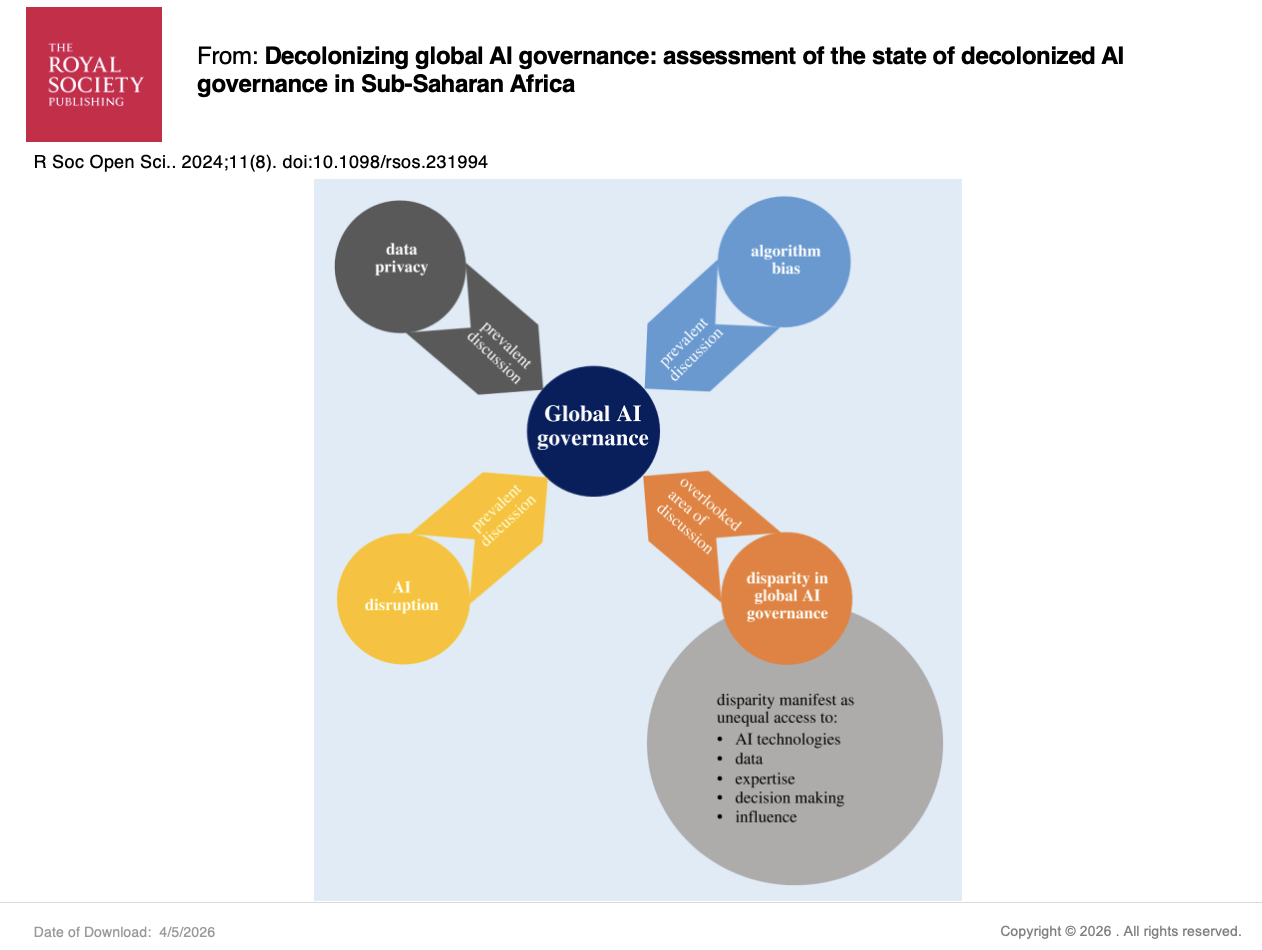
The AI Equity Divide in Global Development
The "AI as tool, not threat" framing protects a certain kind of practitioner. It does very little to protect the local staff, the enumerators, the translators, the community health workers whose knowledge underpins the entire operation but whose labor is most easily automated or outsourced.
And there's something worth sitting with here. The international development sector has spent years — rightly — interrogating its own power dynamics. Who sets the agenda? Whose knowledge counts? Who benefits? We've called this localization. Decolonization. Shifting the power.
But if we adopt AI at scale without asking who built these systems, whose data trained them, and whose jobs disappear when they're deployed, we risk encoding a new layer of inequality on top of the old one. As Stanford's Human-Centered AI Institute has put it: if the skill of building AI is concentrated among western-educated engineers, and the capital among Silicon Valley venture capitalists, then their values and priorities are shaping which problems AI is used to solve — without input from the people most affected.
That's not localization. That's the opposite of it. And this is precisely why the question of localization and AI needs to be part of the same conversation in your organization.

The Beyond Social Science Reframe: Asking a Better Question
So let's reframe the question.
It's not: will AI replace jobs in international development? The more honest question is: whose jobs, whose knowledge, and whose futures are being shaped by decisions that most affected communities have no voice in?
Technological change has never been neutral in this sector. It reflects the power relations already present. What's different now is the speed — and the weight of legitimacy that AI carries with it. When a model produces an output, it feels like objectivity. But it isn't. It's a set of choices, made by people with power, embedded in code.
UN Secretary-General António Guterres has warned that the fate of humanity must never be left to the "black box" of an algorithm — that human oversight of AI decision-making is essential to upholding human rights. In development work, that principle has to go further. Oversight isn't enough. We need to ask: who is in the room when these systems are designed?
On the "AI for good" narrative
Not because AI can't do good — it can and does. But the sector has a pattern of adopting innovations that serve organizational efficiency more than community benefit. The "AI for good" framing often makes it harder, not easier, to ask the hard questions. The same scrutiny we apply to any intervention — does this actually work for the people it's meant to serve? — has to apply here too.
On the "AI for good" narrative
Not because AI can't do good — it can and does. But the sector has a pattern of adopting innovations that serve organizational efficiency more than community benefit. The "AI for good" framing often makes it harder, not easier, to ask the hard questions. The same scrutiny we apply to any intervention — does this actually work for the people it's meant to serve? — has to apply here too.
What This Means for Development Professionals
If you're working in the future of work in the NGO sector — at any level — here are three things worth sitting with.
Get specific about tasks, not just jobs. The honest accounting isn't "my job is safe." It's: which parts of my work are at risk, and what does that mean for how I invest in my own learning? The ILO predicts that while roughly one in four jobs will be transformed by AI, this doesn't necessarily mean net losses — but it does mean that adaptability becomes a core professional skill, not a nice-to-have. Developing skills in NGO project management, data literacy, and adaptive leadership are exactly the kinds of investments that matter now.
Be a critical consumer of the "AI for good" narrative. The "AI for good" framing can make it harder to ask hard questions — not because the intention is wrong, but because the language of progress tends to foreclose scrutiny. Apply the same rigor to AI adoption that you'd apply to any intervention: who benefits, who's at risk, and what does success actually look like?
Push your organization on localization and AI in the same conversation. If your organization says it's committed to shifting power to local partners, ask what that means when AI procurement decisions are made centrally. Local partners need a seat at that table — not just as end-users, but as co-designers. This is where digital transformation with an equity lens becomes not just a learning priority but an organizational accountability.
Be a critical consumer of the "AI for good" narrative. The "AI for good" framing can make it harder to ask hard questions — not because the intention is wrong, but because the language of progress tends to foreclose scrutiny. Apply the same rigor to AI adoption that you'd apply to any intervention: who benefits, who's at risk, and what does success actually look like?
A Question to Leave You With
In your organization — who is most at risk of being displaced by AI adoption, and have they been part of the conversation about how it's being introduced?
Not as a box to check. As a genuine question of justice.
The international development sector has the frameworks to ask that question well. It has years of hard-won practice in naming power and centering equity. What it needs now is the will to turn those frameworks on itself — before the decisions are already made.
Keep thinking with us
If this raised questions for you, the Learning Loop Guide is a free resource that helps development practitioners turn complexity into clearer thinking and more intentional action. Download it at Beyond Social Science: Learning Loop Guide.
And if AI is showing up in your work — and you want to talk about who's not at the table — we'd love to hear from you. That exchange is part of how we think better together.
Resources
Created with